Kpop | <b>K-pop</b> against Kim: the radio broadcasts that have incensed North <b>...</b> |
- <b>K-pop</b> against Kim: the radio broadcasts that have incensed North <b>...</b>
- Krowdpop lets fans crowdfund <b>K-pop</b> concerts around the world
- <b>K-Pop</b> Idol Rain Relishes In Success Of First Lead Role In Drama <b>...</b>
| <b>K-pop</b> against Kim: the radio broadcasts that have incensed North <b>...</b> Posted: 18 Aug 2015 09:00 PM PDT South Korean soldiers at the border between the two countries. Photograph: Pool/Getty Images South and North Korea are engaged in a high-volume propaganda war, with the recent resumption of radio broadcasts across the demilitarised zone setting off a chain of events that have led to Kim Jong-un to threaten military action. But what exactly is in these broadcasts that have so upset fragile relations between the two Koreas? Related: Kim Jong-un puts troops on 'war footing' after two Koreas exchange artillery fire Radio warRadio has been a battleground between North and South Korea since a truce in the Korean war in 1953, with broadcasting and signal-jamming taking place on both sides. The stretch of no-mans-land between the countries has been described as one of the busiest for radio-waves in the world. The South broadcasts Voice of Freedom radio, one of three stations that transmits to the DPRK, and one of the oldest. "It usually broadcasts about ethnic homogeneity, the superiority of the South Korean system, and various types of K-pop," said an insider, speaking on condition of anonymity. Related: Ask a North Korean: do you love K-pop too? "It used to be more stridently [against] North Korea in the past, but since the 1990s it has been trying to describe the reality of democratic society as a more effective means of psychological warfare," another source said, also anonymously. Broadcasts from the North are said to be more directly bellicose. A South Korean military official told the Seoul-based newspaper Kyunghyang Sinmun that "the DPRK's broadcasts against the South deal with slander of the South Korean government, as well as promoting the North Korean regime," adding that the North's speakers were old and rusty and sometimes difficult to understand. A source said the North's main reason for broadcasting was to drown out the Voice of Freedom, adding that the South would in turn increase the volume of its own loudspeakers. Tuning inVoice of Freedom plays on FM radio in Seoul, as well as shortwave over the border. Its broadcasts include a combination of casual conversation alongside anti-DPRK content, an afternoon's listening revealed. One day last week it featured defectors talking about their lives in the South, a discussion about how to deal with hot weather and a programme of Buddhist preaching. Well-known journalist Ju Seong-ha, a defector, participated in a segment called Read the Rodong Sinmun Again, analysing North Korea's state-run newspaper. Ju and the anchor criticised Kim Jong-un's behaviour, mocking staged photo-ops of him getting off a plane as though he were travelling on a state visit. "No foreign country will welcome Kim Jong-un, because he is a dictator. Thus, he is playing the king alone, on the red velvet," Ju said. Other content focussed on human rights abuses in North Korea, a country compared to Nazi Germany in a 2014 UN report. On this occasion, the treatment of South Korean worker Yoo Seong-jin during his illegal four month detention in 2009 was condemned. Related: Two South Korean soldiers injured in apparent landmine explosion on border Between shows, the station broadcasts pop music. Some songs reach back to pre-K-pop days, while others revel in the vibrant, hyper-modern sound that has made helped make South Korea a soft-power superstar. A version of this article originally appeared on NK News  |
| Krowdpop lets fans crowdfund <b>K-pop</b> concerts around the world Posted: 27 Aug 2015 12:06 AM PDT K-pop is huge. Sometimes called "Korea's greatest export," it's a US$3.4 billion industry and counting. Well-choreographed supergroups like Girls' Generation and Big Bang made the music phenomenon huge well before the invisible-horse rider broke YouTube, and the craze has spread beyond Asia to all corners of the world. Look at this guy who took the K-pop obsession to the next level. Investors are also seizing opportunities in the startup scene, with Softbank acquiring DramaFever, Rakuten acquiring Viki and, in turn, Viki acquiring Soompi just last week. 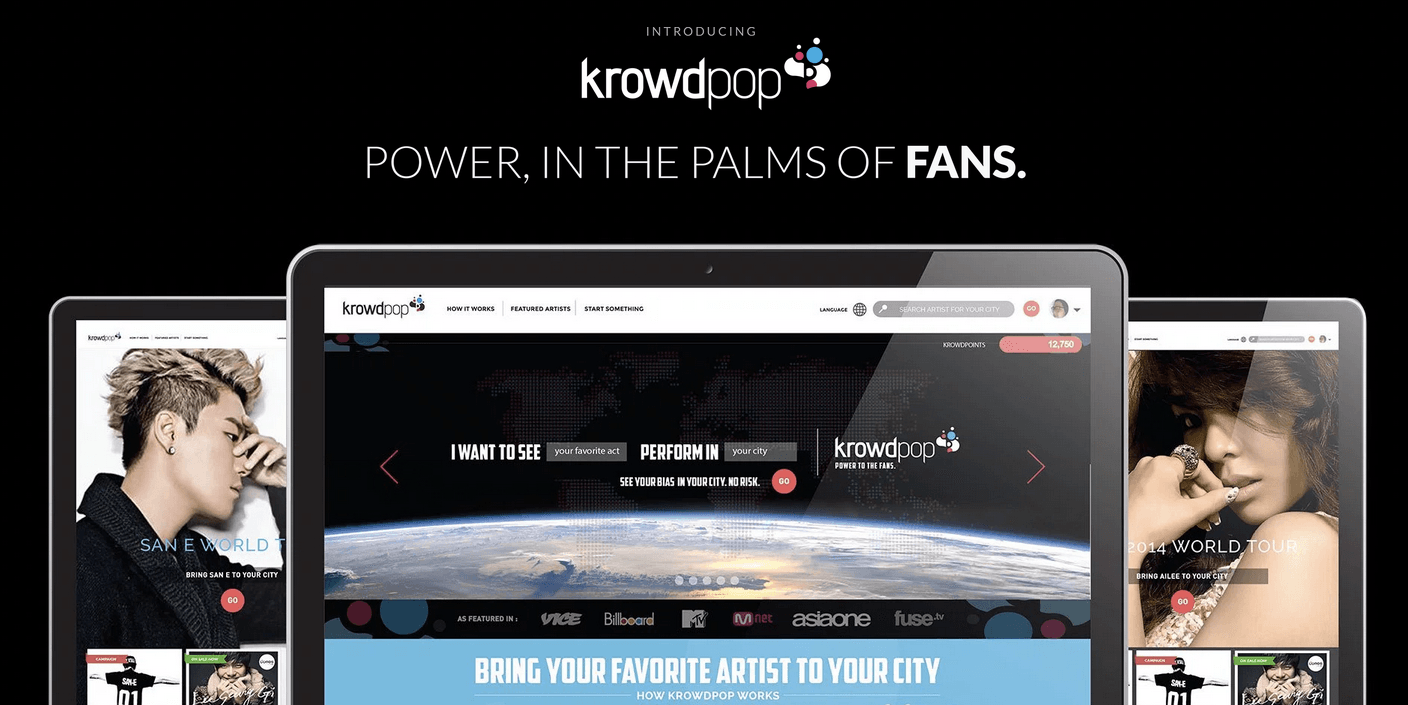 Krowdpop encourages the fans to turn their ideas into reality. But the thriving industry has struggled with its global reputation because of unscrupulous people who want to capitalize on unwitting fans or partners, giving Korea a bad rap. That is what Korean-American entrepreneur Richard Choo found out in his brief foray producing K-pop concerts. "After producing shows, I started realizing that K-pop has a lot of difficulties getting out to the foreign market because there are so many assholes in the entertainment industry," he recalls. So he sought to disrupt the K-pop concert market by letting fans call the shots with K-pop United. Under the tagline "power to the fans," the startup runs a crowdfunding site called Krowdpop that allows fans to create campaigns to bring their favorite K-pop idol to their town, from Jay Park in Brazil to Ailee in Istanbul. So instead of middle-aged men trying to figure out who teenagers in Guatemala want to see, Krowdpop encourages the fans to come up with ideas and turn them into reality. Star appealKrowdpop is also a payment channel that manages ticket purchases, delivering a 100 percent refund to fans if the show is cancelled, thus minimizing losses to buyers. Early-bird Krowdpop tickets give the added perk of allowing the fan to meet the artist and get an autograph and a high-five at the end of show. It also takes out all the guesswork even for major agencies, which have problems connecting with promoters on the ground to produce and finance the shows. A production by YG (think Psy and 2NE1) for 20,000 fans could cost US$2 million per show, and the risks are even higher when the customers are kids without their own incomes. Less famous singers who are too small for promoters to bet on can catch a break if their fanbase mobilizes. 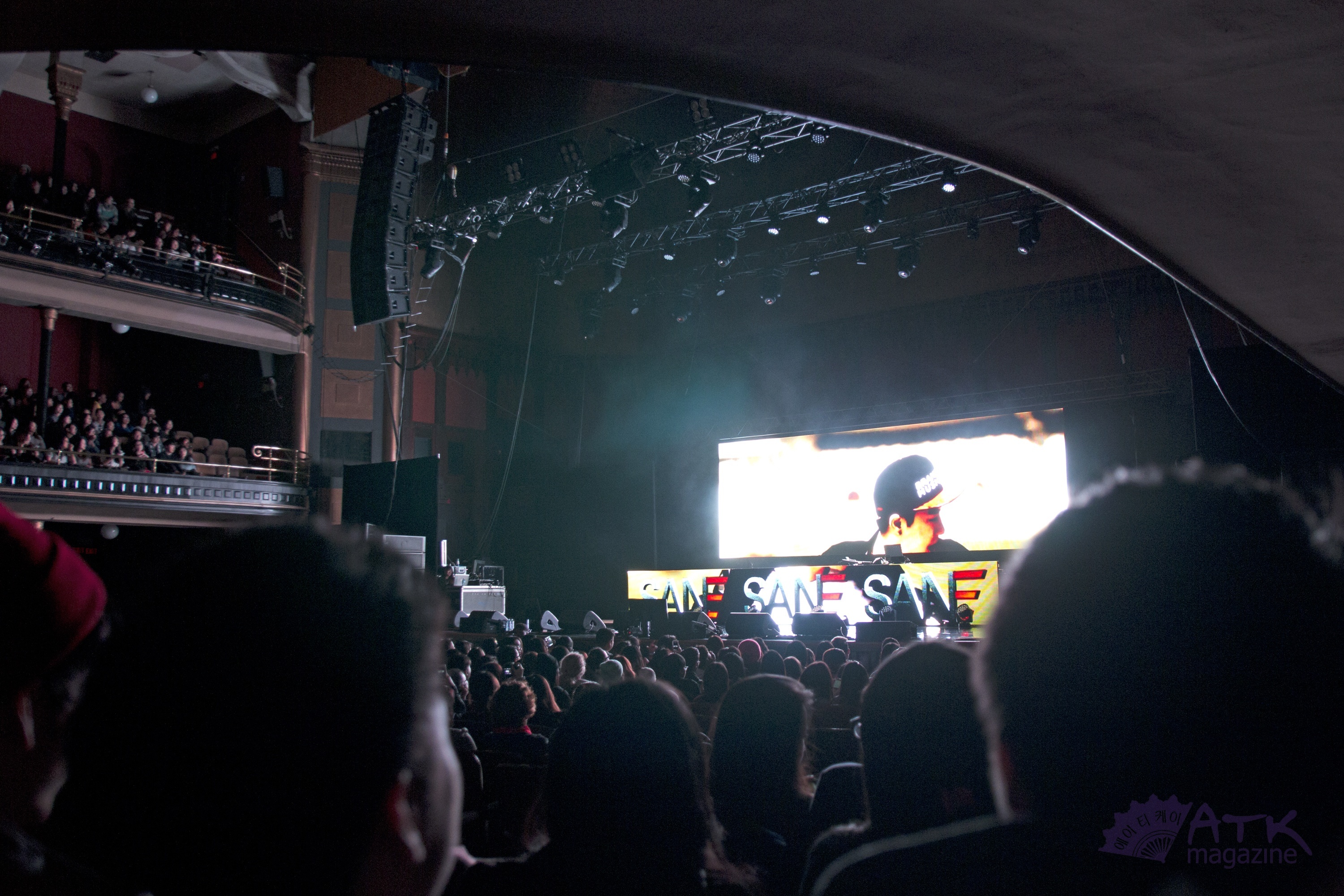 Hip-hop rapper San E performs in March for the Unite The Mic Show in Toronto. "On the promoter's side, it minimizes the risk. On the artist's side, all the artists that don't have any kind of way to get to the foreign market now has an opportunity to do so. And from the fan's perspective, now you can finally get to see who you want to see," Choo explains. All the startup does is connect the fans, the stars, and the promoters, without fronting any funds because the customers pay up front. Boom, everybody's happy – including the startup, which raked in US$600,000 in total revenue in 2014, its first year. Getting burnedChoo was sick of the entertainment industry when he set up this new startup. After helping to put on a K-pop concert for the heartthrobs JYJ – who were working with Kanye West and a creative director for Mariah Carey – he realized how big the trend was for K-pop. He got together with an old partner to put on a K-pop show for Billboard Magazine at MGM Las Vegas in 2011, but things took a turn for the worse. "I got screwed by my partner. I got swindled pretty hard, and it left such a bad taste in my mouth because I was never that into entertainment. And I said, this sucks, because it actually hurts a lot of people," he recalls. So instead of diving back into showbusiness, he created K-pop United as a nonprofit in the US to hold a charity event called the One Wish Campaign, which helps K-pop fans in need. It had its heartstring-tugging beginnings in 2012 to crowdfund a trip for 15-year-old bone cancer patient Emily Vang. One of her wishes was to meet her idol, Junsu of boy group JYJ, whose songs helped her get through chemotherapy. One Wish rallied people to raise money to fly her from Wisconsin to downtown Los Angeles, where she was taken backstage at a JYJ concert and Junsu sang to her – on her 16th birthday. Emily is now healthy and living a normal teenage life, Choo says. Choo left California and K-pop behind in 2013, moving to Korea to do banking. But after getting sucked into Seoul's bourgeoning startup scene, he bootstrapped the revival of K-pop United in January 2014 as a for-profit company based in Seoul. 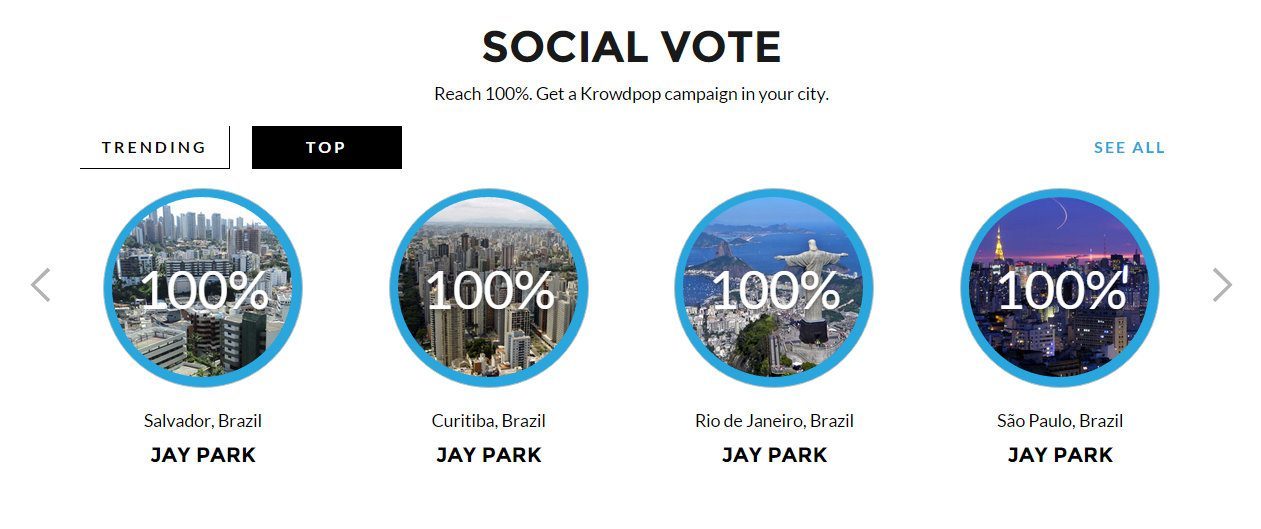 Brazilian crowdfunders really like Jay Park. Krowdpop got big when it raised US$450,000 a few months later to help the rising boy group Teen Top play in four cities across the US and Canada, marking the first time ever that a K-pop celebrity was crowdfunded for a tour, according to Choo. The show was done in a month and a half, rather than the typical six months. In Toronto, Mayor Rob Ford even gave K-pop United an award, and now there is a K-pop show every four months in the city. "It just reinstilled that K-pop is actually here to stay in the market […] and the promoters are starting to use our platform to get shows done," Choo says. Ebb of the Korean WaveWith its style, culture and fashionability, now Korea's high-end culture as the "Italians of Asia" has put the country on the relevancy map. After growing up in northern California and being asked whether he was Chinese or Japanese, Choo says it's finally cool to be Korean, and he's glad to do his part in the movement. "The changes that we're making here that give me the most emotional satisfaction are because we're not just a technology product in the most interesting time to be in tech in Korea – it's that we're also a cultural product, because it's one of the most interesting times to be Korean in the world now," he says. But South Korea can't ride the K-pop culture wave forever. Its biggest threat is the rise of China in global entertainment. Even now, Choo says Chinese companies are picking out Korean content and producers or even buying up entertainment companies, and Korea is starting to get lost in the fray. "The longer they can push out this wave, the more relevancy we all have as a country. As soon as this thing dies, it's kind of game over, unless we can find out what else [to push]."
K-pop United is not worried as its business model can be translated to any other music genre. Its bread-and-butter K-pop niche is keeping them busy for now – the next gig is for Jay Park in Brazil in October – but Choo expects Krowdpop to spread to US acts by the end of next year. Targeting expansion in Southeast Asia, China, the US, and South America, K-pop United aims for US$500 million in annual revenue by 2017. It is now forming content deal partnerships with major promoters worldwide to help put on the tours, and also plans to expand into enterprise services with big data. For that, it is teaming up with a group of scientists and students at HKUST to refine an algorithm that analyzes concerts to help promoters understand the market. Meanwhile, the One Wish Campaign lives on, having brought 400 kids mostly in the US to meet their idols. On its altruistic side, K-pop United wants to give the mic to more indie groups to connect with fans. While major label artists' incomes are skyrocketing, others are struggling to gain the spotlight or find a global audience. Choo wants to find ways to help indie musicians make money by having fans directly support them. In the future, K-pop United might become a go-to for music lovers who want to live chat with artists. "We give power to the fans, support music, but create community on the local level," says Choo. "And if we can have that in every country in the world, I think that I'd be pretty happy about that." |
| <b>K-Pop</b> Idol Rain Relishes In Success Of First Lead Role In Drama <b>...</b> Posted: 19 Aug 2015 11:48 PM PDT When it comes to K-dramas, most people – especially those who are new to it – automatically believe all of the shows featuring Korean actors originate from Korea. Such a misconception probably derives from the fact the term is shorthand for "Korean dramas." However, it has become more of a blanket term that includes other East Asian dramas, especially ones from Taiwan and China, despite the fact that they are not K-dramas. To be frank, such confusion can be somewhat justified given two facts. The first fact is that true K-dramas (ones originating from Korea) can be popular in other East Asian countries. This is definitely true for Kim Soo Hyun. The Korean actor of Producer had major popularity in China while starring in an earlier K-drama, My Love From Another Star. Apparently, Soo Hyun's appeal was so big, Korean coffee chain Caffe Bene hired him as their spokesperson to implement more branches in China. As for the second fact, there are many K-drama stars and K-pop idols who act in Chinese and Taiwanese dramas. With that in mind, Jung Ji Hoon – better known by his stage name "Rain" – isn't just an excellent example, but also a testament to its success. News reports now show that Rain is enjoying tremendous popularity in China for his role in Chinese drama Diamond Lover. To understand just how popular Rain is in China, Diamond Lover boasted over 3.3 billion views since Thursday, August 13, 2015, when the 42nd episode of the 68-episode drama aired, as reported by KpopStarz. It should also be noted the drama's original soundtrack is also receiving a lot of praise in which Rain contributed both as a singer and producer. China's news site QQ provided the following statement pertaining to Diamond Lover, which was later presented on Korean news site OSEN.
It also helps out that both Rain and the female lead of Diamond Lover, Tiffany Tang, have excellent chemistry, as reported by KdramaStars. Said chemistry was probably gained from their previous time they worked together for the movie For Love Or Money. In the end, it is good that Rain is delivering with his role in Diamond Lover. If he did not, the drama would have paid a hefty price for nothing since it was previously reported Rain got paid a whopping $5.4 million to star in it. [Image via Rain Bi Jung Ji Hoon's Facebook Community Page] |
| You are subscribed to email updates from kpop - Google Blog Search To stop receiving these emails, you may unsubscribe now. | Email delivery powered by Google |
| Google Inc., 1600 Amphitheatre Parkway, Mountain View, CA 94043, United States | |

No comments:
Post a Comment